


RESEARCH AT MEDICAL MUTTS
ADVANCING THE SCIENCE OF MEDICAL ALERT AND ASSISTANCE DOGS
Jennifer Cattet, Ph.D., founder of Medical Mutts, has contributed to published research on dogs’ ability to detect odor changes associated with epileptic seizures, hypoglycemia, and COVID-19. Today, Medical Mutts continues to collaborate with research teams in the United States and France on studies involving seizures and assistance dogs for autistic adults.
WHY RESEARCH MATTERS
Turning Canine Abilities Into Scientific Evidence
Dogs can detect changes associated with medical conditions, but many questions remain. We still need to identify the scent signatures they recognize, when those odors are produced, and how samples should be collected and preserved.
Research helps validate what we observe in training, strengthens the credibility of medical alert dogs, and expands our understanding of how dogs may assist people living with challenging health conditions.
Medical Mutts contributes expertise in canine behavior, scent detection, and service-dog training to published and ongoing research in the United States and France.
WHAT WE STUDY
Our Research Areas
Our published and ongoing collaborations focus on medical scent detection and the ways assistance dogs may support people with disabilities.

Seizure detection
Published and ongoing research investigating whether dogs can recognize odor changes associated with epileptic seizures.

Diabetes and hypoglycemia
Published research examining dogs’ ability to identify hypoglycemia-related odor samples from people with type 1 diabetes.

COVID-19 detection
Published research investigating whether dogs can distinguish odor samples associated with symptomatic and asymptomatic COVID-19.
Assistance dogs
and autism

Ongoing international research examining interactions between assistance dogs and autistic adults.
PUBLISHED STUDIES
Peer-Reviewed Research
Jennifer Cattet, Ph.D., has co-authored peer-reviewed studies examining dogs’ ability to detect health-related odor changes under controlled conditions. These studies contribute to the growing scientific understanding of canine olfaction while also identifying questions that require further investigation.
Laboratory detection of an odor does not necessarily mean that every dog can provide a reliable real-world medical alert. Training, individual differences, environmental conditions, sample collection, and the transfer of learning from controlled settings to daily life must all be considered.
COVID-19
2026
ANIMALS
01
Dogs’ Detection of Symptomatic and Asymptomatic SARS-CoV-2 by Non-Working Dogs
This study evaluated whether pet dogs without previous professional scent-detection experience could be trained to distinguish odor samples associated with symptomatic and asymptomatic SARS-CoV-2 infection under controlled laboratory conditions.
The research examined both the potential and the limitations of using non-working dogs for this type of scent detection.
Citation:
Cattet, J., Retornaz, F., Munier, F., Collignon, C., & Gaunet, F. (2026). Dogs’ detection of symptomatic and asymptomatic SARS-CoV-2 by non-working dogs: Feasibility and limits under controlled laboratory conditions. Animals, 16(3), 480.
SEIZURES
2019
SCIENTIFIC REPORTS
02
Dogs Demonstrate the Existence of an Epileptic Seizure Odour in Humans
This study investigated whether epileptic seizures are associated with a distinct odor that trained dogs can recognize.
During controlled scent-discrimination tests, all five participating dogs distinguished seizure samples from non-seizure samples. The findings provided early scientific evidence that epileptic seizures may be associated with recognizable olfactory characteristics.
Citation:
Catala, A., Grandgeorge, M., Schaff, J.-L., Cousillas, H., Hausberger, M., & Cattet, J. (2019). Dogs demonstrate the existence of an epileptic seizure odour in humans. Scientific Reports, 9, 4103.
HYPOGLYCEMIA
Dogs Can Be Successfully Trained to Alert to Hypoglycemia Samples From Patients With Type 1 Diabetes
2015
DIABETES THERAPY
03
This study examined whether dogs could be trained to distinguish hypoglycemic samples from other samples collected from people with type 1 diabetes.
The results demonstrated that dogs can be trained to recognize and alert to hypoglycemia-related odor samples under controlled conditions. The study also highlighted the need for continued research into training standards, reliability, and the specific chemical signature the dogs detect.
Citation:
Hardin, D. S., Anderson, W., & Cattet, J. (2015). Dogs can be successfully trained to alert to hypoglycemia samples from patients with type 1 diabetes. Diabetes Therapy, 6, 509–517.
MEDIA COVERAGE
Research in the News
Our research on dogs’ ability to detect health-related odor changes has been featured by international science and news organizations.


ONGOING COLLABORATIONS
Research in Progress
Medical Mutts continues to collaborate with researchers in the United States and France to expand scientific understanding of medical detection and assistance dogs.

Advancing Seizure Detection Research
Medical Mutts is participating in two ongoing studies investigating canine scent detection related to epileptic seizures.

Assistance Dogs and Autistic Adults
Medical Mutts is also participating in international research exploring scent detection in relation to autism.
Because these studies are ongoing, additional information and findings will be shared after the research has been completed and scientifically reviewed.
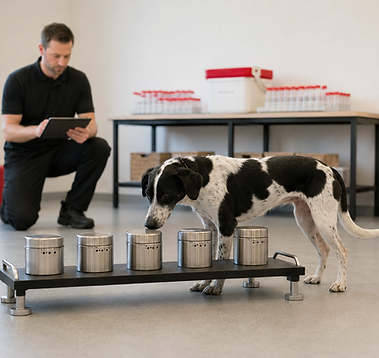
How Dogs Participate in Research
The methods used vary according to the research question, but every project should protect the welfare of the participating dogs and produce information that can be evaluated objectively.
Dogs participate through carefully structured, reward-based procedures. Training and research sessions take each dog’s comfort, motivation, behavior, and ability to disengage into consideration.


Sample Collection


Controlled Presentation
Samples are presented in a structured manner designed to reduce unintentional cues and other factors that could influence the dog’s response.


Results Recorded
Responses are documented and analyzed to determine whether performance can be distinguished from chance and whether the findings support the research question.
The dog is trained to perform a specific behavior when the target odor is detected.


The Dog’s Indication
Samples are collected, handled, and stored according to the protocol established for each study.
Scientific rigor and humane training must work together. Reliable research depends on well-designed protocols, careful observation, appropriate controls, and respect for every dog involved.

RESEARCH COLLABORATION
Partner With Medical Mutts
Medical Mutts welcomes opportunities to collaborate with universities, healthcare researchers, research institutions, and organizations studying medical scent detection, assistance dogs, canine behavior, learning, and the human-animal relationship.
We are especially interested in research that advances scientific understanding while protecting canine welfare and establishing realistic expectations for the people who may ultimately depend on trained assistance dogs.